



Immersion Cooling Servers
Immersion Cooling Servers for High-Density AI Data Centers
Unlock high compute density with immersion cooling servers engineered for power-intensive AI workloads. BEIJING YINTAI delivers advanced liquid-cooled server solutions for AI inference, deep learning, and GPU-dense compute clusters where traditional air cooling limits performance, efficiency, and rack density.
As AI data centers deploy next-generation GPUs, power consumption and heat generation have surged beyond the limits of standard HVAC systems. Our immersion cooling server portfolio transfers heat directly from server components into a dielectric coolant. Under a suitable system and facility design, this approach can reduce thermal constraints, reduce server-fan energy, and support low-PUE (Power Usage Effectiveness) strategies. Project teams may target PUE levels near 1.05 only after validating workload, heat-rejection, climate, redundancy, and measurement boundaries.
Product Overview
| Feature | Description |
|---|---|
| Native Immersion Design | Native immersion-ready configurations, with reference models such as S6285i, S6485i, and A6485i subject to current availability and project qualification. |
| High-Density Compute | Supports mixed CPU and GPU workloads, maximizing compute power per square meter for AI and HPC applications. |
| System-to-Fluid Compatibility | Project-specific compatibility review covers plastics, adhesives, cables, seals, labels, and other materials exposed to the selected dielectric fluid. |
| Integrated Infrastructure | Project scope can include servers, immersion tanks, Coolant Distribution Units (CDUs), secondary loops, heat rejection, and monitoring systems. |
| Acoustic Reduction | Fanless server design significantly lowers data center noise levels, targeting acoustic emissions below 40dB depending on configuration. |
| Energy Efficiency | Fanless server configurations can remove server-fan power draw and reduce facility cooling loads; any PUE target is subject to system boundaries, climate, load, and site design. |
Core Technology Modules

Native Immersion-Ready Server Architecture
BEIJING YINTAI coordinates native immersion-ready server configurations rather than relying only on field retrofits. Reference S6285i, S6485i, and A6485i platforms use specialized motherboard and chassis approaches intended for dielectric-fluid operation; model availability and fluid compatibility must be confirmed for each quotation. Reducing or eliminating server-level high-speed fans can lower fan energy and vibration sources, while the chassis layout is selected to support coolant flow across high-heat components. These platforms can be evaluated alongside our high-density AI servers for a workload- and facility-specific design.
Comprehensive Material Compatibility Engineering
A critical challenge in immersion cooling is the long-term interaction between server components and dielectric fluids. Project engineering should review compatibility evidence for PCB substrates, thermal interface materials, plastics, adhesives, cables, seals, labels, and service parts. BEIJING YINTAI coordinates available component and fluid data and, when required by the project, compatibility validation through qualified engineering, manufacturing, or laboratory resources. Final fluid approval, maintenance procedures, and warranty treatment must be documented for the selected configuration.
Advanced Thermal Simulation and Testing
Before deployment, proposed immersion configurations should be reviewed for heat load, coolant flow, pressure drop, component placement, CDU capacity, and facility heat rejection. Depending on project scope, thermal or fluid analysis and sustained-load validation can be performed through qualified engineering and manufacturing resources. Acceptance criteria should be agreed in advance and measured on the final configuration; this process is intended to reduce hotspot and thermal-throttling risk rather than guarantee identical results across every workload or site.
End-to-End Immersion Infrastructure Integration
Implementing immersion cooling requires a holistic approach that extends beyond the server hardware. BEIJING YINTAI can coordinate end-to-end integration within an agreed statement of work, including immersion tanks, Coolant Distribution Units (CDUs), secondary cooling loops, heat rejection, controls, and monitoring interfaces. We support interoperability between the IT equipment and the facility infrastructure, simplifying the transition to liquid cooling and accelerating time-to-deployment for high-density AI data centers. For modular deployments, we also offer containerized immersion cooling deployment options.
Cooling Technology Comparison
| Feature | Air Cooling | Cold Plate Liquid Cooling | Immersion Cooling |
|---|---|---|---|
| Cooling Mechanism | Airflow via server and facility fans | Liquid circulated through plates on specific components | Full submersion in dielectric fluid |
| Heat Capture Efficiency | Low to Moderate | High (for targeted components) | Near 100% (all components) |
| Rack Density Support | Typically up to 20kW | Up to 80kW+ | 100kW+ |
| Server Fan Requirement | Yes (High speed, high power) | Yes (Reduced speed) | No (Fanless design) |
| Target PUE Potential | 1.3 – 1.5+ | 1.15 – 1.25 | ≤ 1.05 (subject to site conditions) |
| Acoustic Noise | High (>80dB) | Moderate | Low (<40dB depending on configuration) |
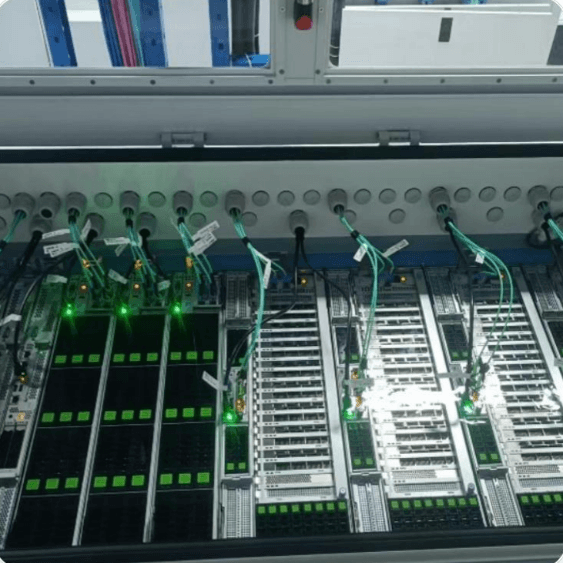
Immersion Cooling Servers
Immersion-ready platforms with direct-to-coolant heat transfer, fanless operation, PUE ≤ 1.05, and noise below 40 dB, enabling high-density racks with integrated cooling and monitoring.
Why BEIJING YINTAI
BEIJING YINTAI coordinates server selection, cooling-system definition, partner engineering, and project integration for native immersion-ready platforms. Our collaborative process helps assess the full system—from material and fluid compatibility to coolant flow, facility heat rejection, controls, and serviceability—against agreed reliability and performance criteria. With our end-to-end integration services, we simplify the deployment of high-density AI infrastructure, helping you achieve high compute density and energy efficiency. For comprehensive facility planning, explore our AI data center solutions.
Applications and Use Cases
High-Density AI Training Clusters
Immersion cooling can support higher GPU density for large language model (LLM) training while reducing thermal-throttling risk when the complete cooling loop is correctly sized.
Green Data Center Initiatives
By reducing server-fan energy and potentially lowering facility cooling demand, immersion cooling can support sustainability programs; any PUE target must be defined and verified at project level.
Space-Constrained Urban Data Centers
Qualified tank and facility designs may support very high power density, including project targets above 100kW per tank, subject to electrical, structural, hydraulic, fire-safety, and heat-rejection constraints.
High-Performance Computing (HPC)
Suitable for scientific research and financial modeling workloads that demand sustained processing under controlled thermal conditions.
Edge Computing Deployments
Enclosed tank designs can reduce direct exposure to dust and humidity, subject to the enclosure rating, service procedure, ambient conditions, and site controls.
Immersion Project Input Checklist
To help us design the optimal immersion cooling solution for your specific requirements, please provide the following information during your initial inquiry:
1. Workload Profile: Primary applications (e.g., AI training, inference, HPC) and required CPU/GPU configurations.
2. Target Rack Density: Anticipated power consumption per tank or rack (e.g., 50kW, 100kW).
3. Facility Infrastructure: Existing cooling capacity, secondary loop water temperature, and available floor space.
4. Fluid Preferences: Any specific requirements or preferences regarding single-phase or two-phase dielectric fluids.
5. Deployment Scale: Number of nodes, tanks, and overall project timeline.
Frequently Asked Questions
You should evaluate immersion cooling when projected rack density, fan energy, acoustic limits, space constraints, or facility cooling capacity make conventional air cooling unattractive. A threshold such as 30kW per rack can be a useful screening point, but the decision should consider workload growth, redundancy, heat rejection, service procedures, fluid policy, and lifecycle economics.
Yes. Reference immersion-ready AI inference models can support multi-GPU configurations for sustained model serving, subject to accelerator, motherboard, fluid, power, and facility qualification. A stable coolant environment can reduce temperature variation, but performance and reliability must be validated on the final system.
In suitable high-density environments, fanless server configurations can remove server-fan energy and the facility may use a different heat-rejection architecture than a conventional air-cooled room. Some projects may target PUE near 1.05, but the result depends on measurement boundaries, climate, load, redundancy, pumps, CDU efficiency, and facility design; savings should be estimated from the customer’s baseline and verified after commissioning.
Deploying immersion cooling typically requires specific facility infrastructure, such as reinforced flooring to support the weight of fluid-filled tanks and a secondary cooling loop to reject heat from the CDU. Our engineering team can assess your site and provide guidance on necessary facility adaptations.
Maintenance involves lifting the server node out of the dielectric fluid. The fluid drains quickly, allowing technicians to replace components similarly to air-cooled servers. Technicians must follow the selected fluid supplier’s safety data sheet, handling requirements, drainage procedure, electrical isolation rules, and site-specific maintenance plan; fluid properties vary and should not be generalized.


