



Used Servers
Engineering-Tested Used Servers for Cost-Effective Infrastructure Expansion
BEIJING YINTAI supplies engineering-tested used servers for organizations needing practical compute capacity without the capital profile of a brand-new fleet. This page is intended for buyers evaluating refurbished enterprise hardware for development labs, backup platforms, disaster recovery capacity, educational environments, rendering farms, or other secondary workloads where budget efficiency matters but uncontrolled hardware risk does not.
BEIJING YINTAI approaches this category as an engineering and lifecycle project rather than a box-moving resale transaction. That means checking platform condition, validating core components, establishing a stable firmware baseline, and matching the available inventory to the customer’s actual use case before shipment.
For Tier-1 production systems, final suitability should be confirmed case by case.
Product Overview
| Capability | What It Means for Buyers |
|---|---|
| Engineering-Tested Intake | Units are screened through inspection, cleaning, component validation, and basic stability testing before release. |
| Reconfiguration Options | CPU, memory, storage, NIC, and accessory choices can be adjusted based on available inventory and final BOM. |
| Budget-Efficient Capacity | Used servers may lower acquisition cost when a suitable platform is available and validated for the workload. |
| Lifecycle Extension | Reuse and redeployment can help customers extract more value from proven enterprise platforms. |
| Project-Based Suitability Review | Workload class, uptime target, and service expectations are reviewed before a recommendation is made. |
Engineering Evaluation and Reconfiguration Workflow
BEIJING YINTAI’s process focuses on the parts of the system most likely to affect redeployment quality: chassis condition, board integrity, fan status, power subsystem behavior, DIMM health, drive recognition, port functionality, and management access. Where appropriate, firmware is aligned to a stable baseline to support more predictable deployment and service handling.
Engineering review also includes configuration matching. A server acceptable for a virtualized dev environment may not fit dense database I/O or a memory-heavy analytics node. The buyer should expect an engineering-inspected platform, not an undefined “as-is” shipment and not a claim of universal compatibility or lifetime equivalence to new hardware.
| Stage | Engineering Focus | Buyer Outcome |
|---|---|---|
| Inventory Intake | Platform identification, serial tracking, visual condition review, and accessory check | Clear starting point for platform selection and parts planning |
| Core Hardware Inspection | Chassis, motherboard, PSU, fan module, drive bay, riser, and connector review | Early detection of obvious wear, damage, or missing components |
| Functional Validation | Power-on testing, memory recognition, storage detection, management port access, and basic I/O checks | Reduced deployment uncertainty before reconfiguration |
| Firmware and Configuration Baseline | Stable BIOS, BMC, RAID, and related baseline alignment where suitable | More consistent setup and handover experience |
| Rework and Matching | Memory, drive, NIC, and accessory adjustments based on available stock and final BOM | A platform better aligned with the intended workload |
| Final Burn-In / Stability Check | Short-duration stress or stability validation appropriate to the platform and project scope | Better confidence for lab, DR, or secondary production use |
Suitable vs Caution Workloads
| Workload Type | Suitability | Why It Fits or Requires Caution |
|---|---|---|
| Development and Test Labs | Strong Fit | These environments usually value flexible capacity, virtualization density, and lower capex more than latest-generation hardware. |
| Backup, Archive, and DR Nodes | Strong Fit | Used servers can be a practical choice for secondary capacity where the design includes redundancy and clearly defined recovery objectives. |
| Rendering, Batch Jobs, and Offline Processing | Strong Fit | Horizontally scalable workloads can often use engineering-tested older platforms effectively when performance per node is not the only priority. |
| Education and Research Platforms | Strong Fit | Universities, training centers, and internal labs often need enterprise features at controlled budgets. |
| Spare Pool or Temporary Expansion | Strong Fit | Used servers can support migration windows, seasonal projects, pilot programs, or hardware replacement buffers. |
| Tier-1 Transactional Databases | Caution | These environments may justify new hardware, longer warranty structures, and tighter availability controls depending on business impact. |
| High-Density Production AI Clusters | Caution | Power, cooling, GPU topology, and support expectations usually require project-specific review rather than a generic used-server recommendation. |
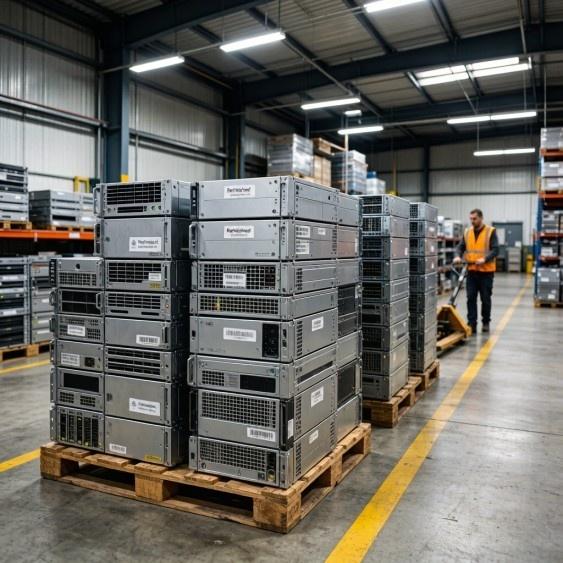
Used Servers
Inspected and validated refurbished enterprise hardware, reconfigured to your specifications for cost-effective capacity without requiring the latest-generation systems.
Why BEIJING YINTAI
BEIJING YINTAI helps international buyers evaluate where used hardware fits within an infrastructure portfolio. For customers that also source General Purpose Servers, lifecycle inspection and maintenance support, custom server and motherboard ODM engineering, or component-level data center GPU repair, this matters because used hardware rarely stands alone. It usually connects to a broader lifecycle strategy that may include spare pools, phased refresh, repair, redeployment, or temporary capacity expansion. An engineering-led partner can support those decisions more effectively than a purely transactional broker.
Applications and Use Cases
In development and QA environments, teams often need large numbers of affordable systems for CI pipelines, software validation, sandbox clusters, and internal tooling. In these cases, engineering-tested platforms can deliver the right balance between cost control and enterprise manageability.
In backup and disaster recovery designs, when combined with a sensible redundancy model and a clearly defined recovery plan, refurbished enterprise hardware can support economically efficient standby infrastructure.
For rendering, media processing, simulation, and batch analytics, buyers may prefer to maximize aggregate throughput per budget rather than invest only in the newest server generation. A further use case is reconfiguration and redeployment during transitions. Customers sometimes need interim infrastructure while new systems are on order, while a room is being upgraded, or while an older fleet is being consolidated. In such projects, used servers can function as a bridge solution, a spare-parts reserve, or a controlled expansion layer subject to final inventory and workload matching.
Selection and Project Planning Guide
Buyers should first define the workload category, expected duty cycle, operating system or hypervisor stack, memory footprint, storage profile, and network speed target. It is equally important to identify acceptance boundaries before quotation. These usually include rack form factor, power supply preference, local spare strategy, preferred CPU family, minimum memory population, boot drive layout, and whether cosmetic condition matters for the deployment environment. If expansion cards or specific drive media are required, that should be stated early because availability may vary by inventory cycle.
For more sensitive deployments, buyers should also describe uptime expectations, maintenance ownership, and whether the server is entering a mixed fleet with standard firmware, imaging, and remote management policies. Delivery timing for used servers can be efficient, but it still depends on inventory condition, rework scope, replacement parts, logistics, and final configuration approval.


