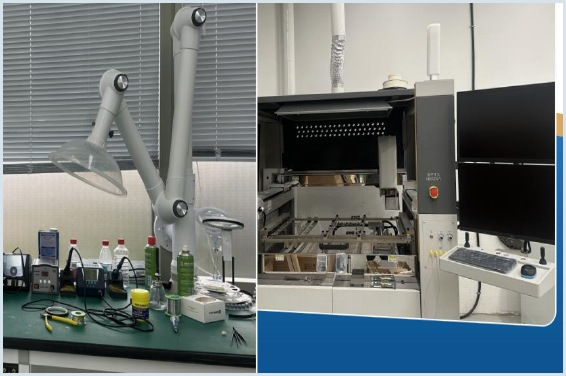



GPU Repair Services
Data Center GPU Repair for AI Accelerators and Compute Hardware
Extend the lifecycle of high-value compute assets with data center GPU repair services coordinated by BEIJING YINTAI. Maintaining accelerator availability is important for AI training and high-performance computing environments, where a failed board can reduce cluster capacity. Component-level diagnosis can help buyers determine whether repair, parts recovery, or replacement is the most practical option.
Through qualified repair partners, we coordinate component-level diagnostics and repair for selected data center graphics cards, AI accelerators, and high-density server hardware. Technical teams evaluate electrical, interface, memory, and thermal faults before confirming repairability and quotation. Where repair is feasible, component-level work may avoid full-board replacement and help recover usable compute capacity.
Product Overview
| Capability | Description |
|---|---|
| Component-Level Diagnostics | Advanced oscilloscope and testing rig analysis to pinpoint electrical, thermal, and interface faults. |
| Comprehensive Repair Scope | Servicing GPU modules, BaseBoards, Switch boards, motherboards, and network interface cards. |
| Precision Rework | BGA (Ball Grid Array) soldering, SMD component replacement, and thermal material renewal. |
| Post-Repair Validation | Functional and workload testing is defined according to the repaired asset and available test platform. |
| Lifecycle Cost Evaluation | Repair may avoid replacement cost when the fault is recoverable and parts are available. |
Core Technology Modules

Advanced Diagnostic Capabilities
Effective data center GPU repair begins with precise diagnostics. Partner laboratories utilize advanced testing equipment, including high-frequency oscilloscopes and specialized diagnostic software, to perform comprehensive board-level and component-level fault analysis. We systematically evaluate the power delivery network (VRM), memory modules (VRAM), PCIe/IB interfaces, and the GPU core itself.
This structured diagnostic approach is used to investigate failures such as initialization errors, ECC memory faults, or devices dropping from the system under load. Identifying the likely fault domain helps target the repair decision and avoid unnecessary component replacement, but final repairability depends on board condition, fault type, test access, and parts availability.
Component-Level Repair and Rework
Repair work can extend beyond board swapping to component-level rework for selected AI accelerators and server boards. Depending on diagnosis and parts availability, partner technicians may perform BGA (Ball Grid Array) or SMD (Surface-Mount Device) rework for memory devices, power stages, interface controllers, and related components.
The service can also address thermal degradation through cleaning, thermal-interface-material renewal, and thermal-pad replacement where appropriate. Repaired units are returned only after completing the agreed functional and workload validation; a unit that cannot meet the acceptance criteria is reported as unsuccessful or otherwise handled according to the approved service terms.
Comprehensive Hardware Coverage
We service a wide range of data center hardware, focusing on the components that are most critical to AI and HPC workloads. Our repair capabilities cover not only the GPU accelerators themselves but also the complex infrastructure that supports them.
This includes HGX and OAM modules, GPU BaseBoards, PCIe Switch boards, server motherboards, and high-speed network interface cards (such as InfiniBand adapters). By offering a comprehensive repair solution for the entire compute node, we simplify the maintenance process and provide a single point of contact for resolving complex hardware failures.
Repairable Asset Matrix
| Asset Type | Examples / Focus Areas | Typical Faults Addressed |
|---|---|---|
| AI Accelerators | HGX modules, OAM modules, PCIe GPUs | Initialization failures, ECC errors, VRAM faults, thermal throttling |
| Server Boards | GPU BaseBoards, motherboards | Power delivery (VRM) failures, component damage, interface issues |
| Interconnects | PCIe Switch boards, Network cards (IB/RoCE) | Link drops, unrecognized devices, signal integrity issues |
| Cooling Systems | Engineered blower-cooled RTX 5090 accelerator options (for qualified deployments) | Fan failures, thermal degradation, acoustic anomalies |
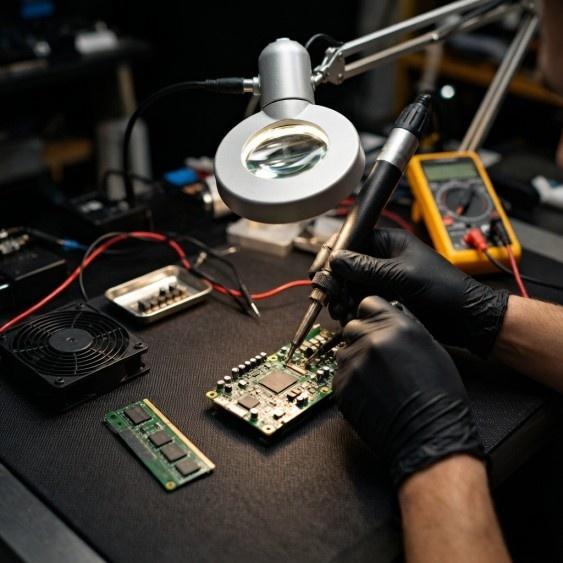
GPU Repair Services
Component-level diagnostics and repair for AI accelerators, GPU BaseBoards, switch boards, and related compute hardware. Oscilloscope-grade fault analysis, BGA rework, and post-repair validation help determine whether repair, parts recovery, or replacement is the most economical path for a failed board.
Why BEIJING YINTAI
BEIJING YINTAI connects you with specialized engineering and repair capabilities designed specifically for the demands of modern data centers. Partner repair laboratories are equipped with the advanced tools and expertise required to service complex, high-value AI accelerators and server infrastructure.
We understand that in AI and HPC environments, downtime is costly. Our repair workflows are optimized for efficiency, focusing on accurate diagnostics, precision rework, and rigorous validation to ensure that repaired hardware performs reliably under load. By choosing BEIJING YINTAI, you gain a trusted partner dedicated to maximizing the lifecycle value of your critical compute assets. For comprehensive lifecycle support, explore our data center operation and maintenance services.
Applications and Use Cases
AI Training Clusters
Evaluate recoverable accelerator faults and return validated units to service where repair is feasible.
High-Performance Computing (HPC)
Support the lifecycle of dense GPU nodes used for scientific simulation, rendering, and data analysis.
Cloud Service Providers
Compare repair economics with replacement for failed assets across larger fleets.
Enterprise IT Infrastructure
Extend the lifecycle of existing server deployments, delaying costly hardware refreshes and maximizing the value of initial investments.
Selection and Project Planning Guide
To initiate a repair request and ensure a smooth triage process, please provide the following information when contacting our team:
1. Hardware Details: Specify the exact model numbers, part numbers, and quantities of the failing components (e.g., specific HGX module versions or PCIe card models).
2. Fault Symptoms: Provide a detailed description of the failure, including error codes, system logs, and the specific conditions under which the failure occurs (e.g., “fails to initialize on boot,” “drops off the PCIe bus under heavy load,” or “reports ECC memory errors”).
3. Usage Environment: Describe the operating environment, including server chassis models, cooling methods, and typical workloads.
4. Previous Actions: Note any troubleshooting steps already taken or previous repair attempts.
Based on this information, our team will perform an initial repairability triage and provide an estimated cost and timeline for the diagnostic and repair process.